A Drone at 7,000 Feet Changes the Airport Security Equation
A reported drone encounter near O’Hare highlights why airport protection must extend beyond physical boundaries, traditional surveillance, and detection alone.

Summary
A reported drone encounter involving American Airlines Flight AA1936 at approximately 7,000 feet near Chicago O’Hare International Airport illustrates an emerging challenge in aviation security: airport operational exposure extends beyond physical perimeters and conventional surveillance capabilities. This article examines how increasingly accessible unmanned aircraft are reshaping airport security requirements, emphasizing persistent airspace awareness, reliable object classification, authorization assessment, and coordinated decision-making. It explores the complementary roles and limitations of radar, radio-frequency sensing, electro-optical and infrared technologies, Remote ID, and behavioral analysis, alongside the operational consequences of false positives and false negatives. The article also addresses the distinction between object identification and flight authorization, the evolving U.S. counter-UAS regulatory landscape, FAA requirements, and expanded authorities under the SAFER SKIES Act. Through Umbrella Aerospace’s adaptive aerial protection methodology—Detection, Identification, Decision, and Response—the article presents a framework for reducing uncertainty, supporting proportionate and legally authorized responses, accommodating legitimate drone activity, and preserving aviation safety and operational continuity. Ultimately, effective airport counter-UAS protection requires redefining security boundaries according to operational exposure rather than physical geography.
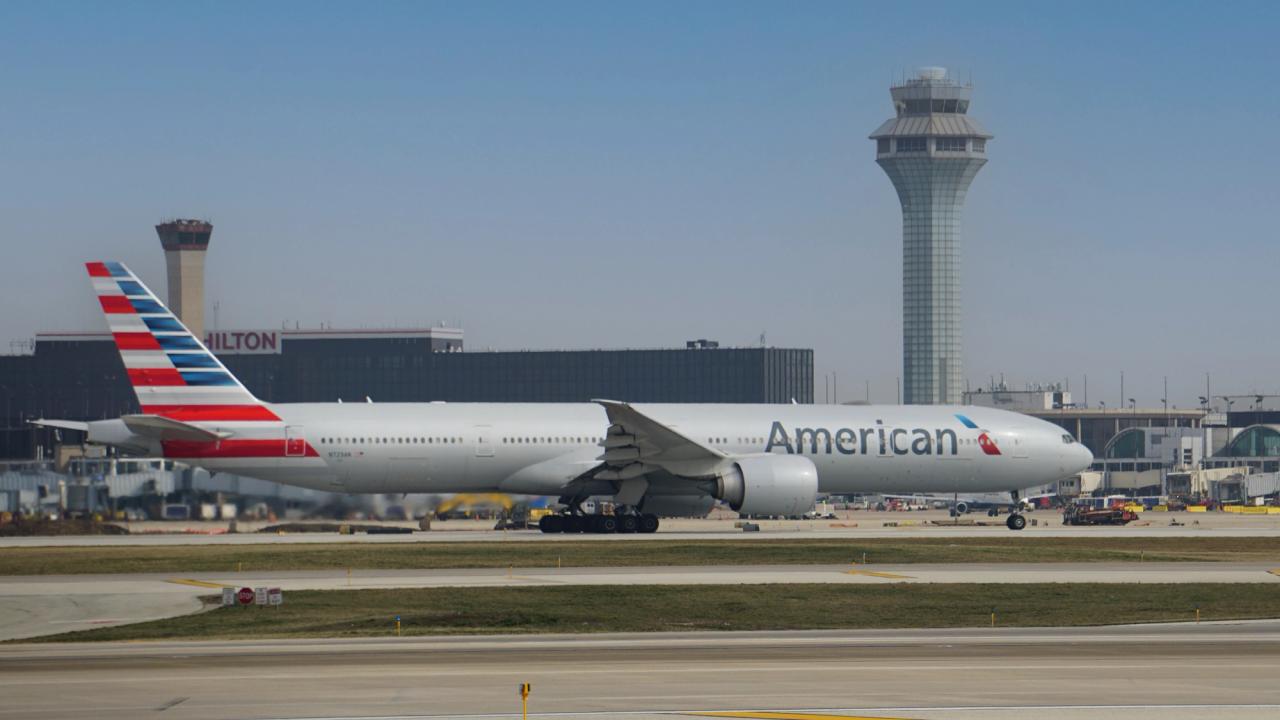
On October 10, 2026, the pilots of American Airlines Flight AA1936 reportedly encountered a drone (opens in a new tab) while departing Chicago O’Hare International Airport. Aviation reporting published four days later placed the encounter at approximately 7,000 feet, with the crew estimating that the object passed within 100 to 200 feet of the aircraft. The flight continued safely to Newark. Although the reported object's identity and proximity have not been independently confirmed, the encounter illustrates a fundamental challenge facing aviation security: an airport's operational exposure extends well beyond its physical boundaries.
The Limits of a Physical Perimeter
Traditional airport security infrastructure is designed around identifiable points of access. Fences, surveillance systems, credentials, and controlled entrances establish layers of protection between public and restricted environments. Unmanned aircraft introduce a different dimension of exposure, one in which proximity to airport property is not necessarily the most meaningful measure of risk.
A potential aerial hazard can emerge above a residential neighborhood, transportation corridor, industrial facility, or body of water while remaining operationally relevant to an airport several miles away. Protection must increasingly account for the airspace through which aircraft move, not simply the ground infrastructure from which they operate.
The Airport as a Dynamic Protection Environment
Airports are not isolated facilities. They operate within interconnected environments shaped by aircraft trajectories, weather, airspace classifications, changing traffic patterns, and surrounding infrastructure.
The introduction of small unmanned aircraft complicates this environment because established aviation surveillance capabilities were not universally designed to detect and classify small aerial objects with diverse flight characteristics.
The Federal Aviation Administration reports receiving more than 100 drone sightings (opens in a new tab) near airports each month. These observations do not necessarily represent confirmed incursions or hazardous encounters, but their frequency demonstrates the ongoing demand for awareness and assessment. The challenge is further complicated by legitimate drone activity. Airports themselves may use unmanned aircraft (opens in a new tab) to supplement inspections, support emergency exercises, and perform other operational functions under applicable approvals.
An effective protection environment must therefore accommodate legitimate unmanned aviation while maintaining the ability to recognize activity that could interfere with airport operations.
From Isolated Detection to Persistent Awareness
Airport protection cannot depend exclusively on identifying individual incidents after they occur. It requires the ability to establish and maintain an evolving understanding of the surrounding airspace.
Persistent airspace awareness introduces continuity into this process. Rather than treating each observation as an isolated event, it considers an object's movement, classification confidence, relationship to legitimate traffic, and behavior over time.
Two drones operating at similar altitudes may present substantially different operational concerns. One may be following an approved inspection route, while another may be approaching an active departure corridor. Their physical characteristics alone do not establish their relative risk.
This distinction reinforces a broader principle: aerial protection is not solely a detection problem. It is an information-quality and decision-making problem.
Identification and the Cost of Uncertainty
Airport environments present difficult classification conditions. Birds, helicopters, small aircraft, authorized drones, environmental clutter, and electronic interference can complicate the interpretation of sensor observations.
Different sensing technologies provide complementary information:
- Radar contributes movement and tracking information but may face limitations involving small objects and environmental clutter.
- Radio-frequency sensing can provide evidence of certain drone communications but may not reliably capture non-emitting aircraft.
- Electro-optical and infrared sensing can contribute visual and thermal classification evidence, subject to environmental conditions.
- Remote ID can provide broadcast identification and location information but does not independently establish operational authorization.
- Behavioral analysis contributes context by evaluating how an object moves within its surrounding environment.
Combining these capabilities can reduce ambiguity, but no individual sensing technology eliminates uncertainty.
The consequences of classification errors are particularly important in aviation. False positives may generate unnecessary alerts, consume operational resources, or contribute to avoidable disruptions. False negatives may allow relevant aerial activity to remain unrecognized. The objective is not maximum sensitivity in isolation. It is reliable classification and risk assessment under operationally realistic conditions.
Beyond aviation safety, these operational disruptions carry broader financial and commercial implications, reinforcing the growing intersection of drone risk, insurance, and business continuity (opens in a new tab).
Identification Does Not Establish Authorization
Determining that an object is a drone answers only one part of the protection equation. Determining whether that drone is authorized requires additional operational and regulatory information.
In October 2026, the FAA reinforced airspace-access requirements (opens in a new tab) for airports planning to use small unmanned aircraft during emergency exercises. Its guidance illustrates how even legitimate airport-sponsored drone operations must be integrated into established aviation procedures. Authorization, however, does not eliminate the need for ongoing awareness. An approved aircraft may experience a malfunction, deviate from its intended route, or encounter changing operational conditions. Conversely, an unidentified drone should not automatically be classified as hostile.
A mature protection architecture must distinguish between object identity, authorization status, observed behavior, operational exposure, and assessed risk. These are connected but fundamentally different considerations.
When the Response Introduces Additional Risk
The airport environment places particularly demanding constraints (opens in a new tab) on counter-UAS response. An intervention intended to address one aerial hazard must not introduce another. The FAA's airport detection and mitigation research program (opens in a new tab) reflects this requirement by evaluating technologies against their potential effects on aviation infrastructure and operations. Federal law similarly establishes coordination requirements for protecting the safety of the National Airspace System.
The regulatory environment is also evolving. The July 6, 2026, interim final rule implementing the SAFER SKIES Act (PDF) (opens in a new tab) establishes a framework through which eligible state, local, tribal, and territorial agencies can exercise expanded counter-UAS authorities under specified conditions. These authorities remain subject to applicable certification, coordination, and operational requirements.
Expanded authority does not mean unrestricted intervention. Airport operators and protection-system providers must continue to distinguish between technical capability and legal permission. Depending on the circumstances, an appropriate response may involve continued observation, notification, coordination with air traffic control, escalation to authorized authorities, or another approved protective measure. In certain environments, restraint is itself an essential protection capability.
Connecting Awareness With Operational Decisions
Umbrella Aerospace approaches adaptive aerial protection through four interdependent functions: Detection → Identification → Decision → Response. The distinction between these functions becomes especially important in environments where legitimate aerial activity is dense and the consequences of error are significant.
Detection establishes the presence of something that warrants observation. Identification develops an understanding of what it may be. Decision evaluates whether that activity warrants intervention, while response remains constrained by applicable authority and operational safety. The effectiveness of the architecture depends not simply on the performance of its individual components, but on how reliably information moves between them.
Redefining the Airport Security Boundary
The reported encounter near O’Hare illustrates a larger shift in aviation protection. As unmanned aircraft become more accessible and operationally capable, airport exposure becomes increasingly difficult to define through geography alone. Physical security remains indispensable, but it must coexist with protection capabilities that account for dynamic aerial activity across approach and departure environments.
The future of airport counter-UAS will depend on the ability to maintain awareness, reduce classification uncertainty, evaluate authorization, and support decisions without compromising legitimate aviation operations. The relevant security boundary is no longer simply where airport property ends. It is where operational exposure exists.

Umbrella Aerospace
Umbrella Aerospace explores adaptive approaches to aerial security, autonomous detection, visual intelligence, and counter-UAS systems designed around responsible innovation, operational stability, and the protection of people and critical environments.