Better Synthetic Data Is Not Always More Synthetic Data
More synthetic data does not always mean better AI. New research shows why dataset curation, targeted generation, and real-world validation matter more than volume.

Summary
Recent computer-vision research suggests that synthetic-data effectiveness depends more on dataset composition, curation, and validation than generation volume alone. Studies across remote sensing, surgical vision, and industrial safety demonstrate how targeted augmentation can address class imbalance, how filtering can improve synthetic-data utility, and why performance gains must be validated against real-world data. These findings point toward a data-centric approach in which model weaknesses guide synthetic generation, dataset selection, and continued evaluation.
Synthetic data solves an obvious problem in computer vision: acquiring and labeling physical data is often slow, expensive, or impossible at the scale modern perception models require.
That has made volume one of synthetic data's most intuitive selling points. A physical collection campaign may require sensors, personnel, locations, equipment, repeated operations, and subsequent annotation, while a synthetic pipeline can potentially produce thousands or millions of labeled variations without recreating each condition physically.
An important refinement is emerging, however. The question is no longer simply whether synthetic data can increase the size of a training set. Increasingly, the question is which synthetic data actually improves performance when the model encounters reality. Several studies published in 2026 point toward the same conclusion across very different computer-vision domains: synthetic data becomes most useful when it is deliberately selected to address a defined weakness in the underlying dataset.
This distinction also reinforces the importance of combining synthetic and real-world data in AI perception training (opens in a new tab), where the value of generated examples depends on how effectively they complement physical observations.
A Real-World Example of the Data-Gap Problem
A paper released August 17 (opens in a new tab) examines a problem far removed from laboratory computer vision: identifying battle-damaged agricultural fields in Ukraine using satellite imagery. The researchers faced a familiar perception problem: Labeled imagery was scarce and the available classes were imbalanced. Rather than simply enlarging the dataset indiscriminately, they generated synthetic examples using generative adversarial networks and diffusion models, then used those images specifically to augment the real training data. Importantly, evaluation was conducted on an exclusively real test set.
The best configuration, using balanced diffusion-model augmentation, increased overall accuracy from 84% to 88%. More revealingly, balanced accuracy increased from 67% to 81%, macro F1 from 65% to 78%, and recall for the underrepresented class from 41% to 69%.
The significance extends beyond remote sensing. Synthetic data was valuable not merely because it made the dataset larger, but because it addressed an identifiable structural weakness: insufficient representation of important classes. That distinction applies across perception applications where data scarcity, imbalance, or incomplete coverage can limit model performance.
Curation Can Matter More Than Volume
Another 2026 study reaches a similar conclusion (opens in a new tab) through a completely different application. Researchers developing computer vision for robotic surgical suturing created synthetic imagery because annotated surgical footage is scarce and costly. They then enhanced the generated imagery and introduced an automated filtering process designed to reject synthetic samples containing distortions or misalignment.
The result was particularly instructive: the curated synthetic dataset outperformed the larger unfiltered dataset when models were evaluated against real imagery. The researchers' broader conclusion was that filtering generated data could improve sim-to-real transfer rather than assuming every synthetic sample contributed equally to the training process.
The lesson is broader than the particular filtering architecture used in the study. Generation itself is only part of dataset engineering. Once artificial data can be produced inexpensively, the bottleneck begins to move from *Can we generate enough examples?* toward *Which generated examples deserve to enter the training set?*
Synthetic Data Should Be Judged by What Happens on Real Data
This shift also changes how synthetic-data quality should be measured. A synthetic image can appear convincing to a human observer while containing characteristics that cause a perception model to learn the wrong features. Conversely, synthetic imagery does not necessarily need perfect visual realism to improve a particular training task.
The more useful measurement is downstream performance.
The National Institute of Standards and Technology has examined the broader challenge of validating generated data. A February 2026 NIST technical note describes a framework for assessing synthetically generated information (opens in a new tab) using multiple validation measures rather than assuming generation quality from appearance alone.
Although the NIST (opens in a new tab), the underlying measurement principle translates well: artificial data should be evaluated according to the purpose it is intended to serve. For computer vision, that generally means determining whether a model trained or augmented with synthetic examples performs better against independent real-world data.
This is what makes real holdout datasets so important. Synthetic environments provide controllability, while real test data provides an independent measure of whether the learned representations transfer to the physical world.
The Synthetic-to-Real Question Is Becoming More Precise
A May 2026 study of construction-site personal protective equipment detection (opens in a new tab) offers another useful example. Researchers compared real and synthetic training data under a fixed training budget rather than allowing synthetic generation to expand the dataset indefinitely. The study used a fixed real-only test set of 400 images, separate pools of 5,760 real and 4,000 synthetic images, and eleven training configurations with different real-synthetic ratios.
That experimental design reflects a more mature question about synthetic data. The objective is no longer to demonstrate that artificial imagery can be generated at scale. Instead, the researchers asked where synthetic data creates measurable value when the overall training budget remains approximately constant.
The results also provide an important caution against assuming that adding synthetic data will automatically improve a model. Performance varied by detector architecture and mixing ratio. In the original single-run experiments, YOLOv11s and RT-DETR-L reached their highest recall with 90% real and 10% synthetic data, while Faster R-CNN performed best using entirely real data. Additional repeated testing of the YOLOv11s comparison found that the apparent advantage of the mixed configuration was not stable across reruns. The broader lesson is that synthetic-data value can depend on the model, dataset, evaluation method, and deployment problem rather than following a universal mixing formula.
This matters commercially as well as technically. Compute, rendering, storage, model training, data management, and validation all carry costs.
From Dataset Generation to Dataset Selection
Even automatically labeled synthetic imagery imposes processing requirements. Generating examples that contribute little new information may still be less expensive than physical collection, but it is not free. The economic advantage becomes stronger when generation is targeted toward data that contributes measurable value.
This suggests an important evolution for visual simulation infrastructure:
- The first generation of synthetic-data thinking emphasized production: generate data at scale.
- The next generation is likely to emphasize selection: generate the data that changes model performance.
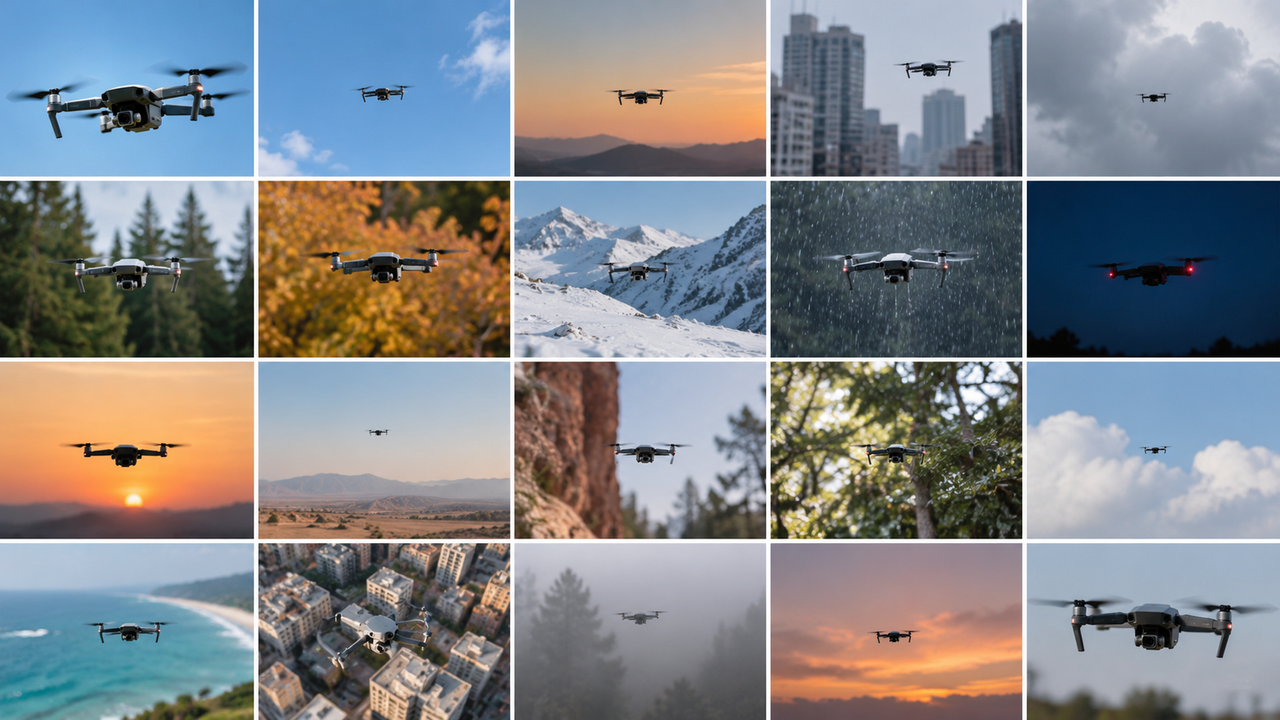
That transition requires a closer relationship between model evaluation and simulation. If evaluation reveals that a detector performs reliably in daylight but degrades against low-contrast backgrounds, that weakness becomes a dataset requirement. Simulation can vary background contrast systematically while holding other parameters stable.
The same process can be applied to more complex failures. If a model struggles when small object scale, haze, and sensor noise occur simultaneously, the pipeline can generate those combinations deliberately. If a newly introduced class is underrepresented, synthetic generation can increase its frequency without unnecessarily expanding classes already well represented in the dataset.
In this model, the dataset becomes responsive to the model. Rather than generating a large synthetic corpus once and treating it as a static training asset, evaluation helps determine what should be generated next. This evaluation-driven approach creates a dataset feedback loop (opens in a new tab), in which identified model weaknesses inform the next generation of synthetic training examples.
Edge Cases Become Dataset Requirements
The same principle becomes especially powerful in the long tail. Edge cases are difficult precisely because normal collection processes underrepresent them. Rare weather, unusual viewing geometry, partial occlusion, sensor degradation, uncommon object configurations, or several unusual variables occurring simultaneously may appear only sporadically in physical datasets.
Synthetic generation allows those scenarios to be intentionally overrepresented. The recent remote-sensing research offers a useful way to think about this problem because it treats imbalance not simply as a limitation of the existing dataset, but as information that can guide augmentation.
The same logic can be extended to model failures:
- A weak environmental condition can become a generation request.
- A poorly represented geometry can become a generation request.
- A new sensor characteristic can become a generation request.
- An emerging object configuration can become a generation request.
This is where synthetic data begins to move beyond augmentation and toward adaptive data infrastructure. Instead of adding artificial examples broadly, the training pipeline can use identified weaknesses to determine where additional coverage has the greatest potential value.
From Edge-Case Data to Impossible Data
There is also a category beyond underrepresented data. Edge-case data describes real conditions for which examples exist but are difficult to accumulate. Impossible data describes scenarios for which representative physical training data cannot practically be obtained, or does not yet exist.
An aircraft may still be represented primarily by CAD geometry. A sensor configuration may not yet be integrated. A hazardous interaction may be inappropriate to recreate repeatedly. A newly identified object or platform may exist without sufficient accessible imagery to train a reliable detector.
In those situations, dataset engineering can begin before traditional collection is even possible. Synthetic environments can provide an initial representation, allowing perception teams to explore detection, classification, sensor configuration, and potential failure modes before substantial real-world datasets become available.
Those synthetic representations still require validation as physical evidence emerges, and they should not be treated as substitutes for eventual real-world testing. Their value is that development no longer has to remain idle while waiting for reality to produce the first usable dataset.
Conclusion
The synthetic-data industry has spent years demonstrating that artificial training data can be generated at scale. The more consequential challenge now is deciding what should be generated and why.
Recent research is beginning to make that distinction measurable. Synthetic augmentation can improve performance when a dataset is scarce or imbalanced. Curated synthetic samples can outperform larger unfiltered collections. Fixed-budget experiments can reveal where synthetic supplementation contributes value, where results depend on model architecture, and where additional artificial examples provide little measurable benefit.
The trajectory points toward a more data-centric development model in which evaluation and generation operate as a continuous feedback loop: evaluate model performance, identify the weakness, define the dataset requirement, generate targeted examples, validate and select the data, retrain, and evaluate against the physical world.
In that cycle, the value of visual simulation is no longer measured primarily by how many images it can produce. It is measured by how efficiently it can produce the missing information that changes model performance.

Yuriy KoshkinFounder & President
Yuriy Koshkin writes about autonomous systems, drone security infrastructure, and evolving aerial risk environments. He is a technology leader and entrepreneur focused on advancing autonomous systems and developing practical approaches to emerging security challenges.