Synthetic + Real: Why the Future of AI Perception Training Is Hybrid
Synthetic and real-world training data work best together, exposing perception models to critical conditions the physical world cannot reliably provide on demand.


Summary
Synthetic data is sometimes framed as a replacement for real-world data. That framing misses its more important role. As computer vision systems move into increasingly complex and safety-sensitive environments, synthetic data can provide controlled coverage of rare conditions, targeted model weaknesses, and scenarios that are expensive or impractical to collect physically. Real-world data remains essential for grounding and validation. Together, they create a more flexible training strategy than either source can provide alone.
Computer vision has traditionally followed a straightforward assumption: the closer training data is to the real world, the better prepared a model will be for the real world. That assumption remains important, but it is no longer sufficient.
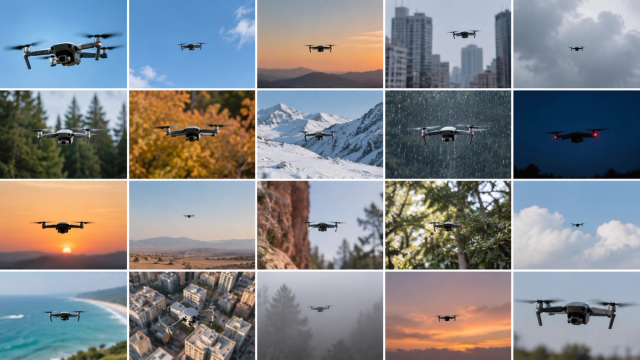
Modern perception systems are expected to operate across changing weather, lighting, backgrounds, sensor characteristics, object configurations, viewing geometries, and increasingly unusual operating conditions. The problem is not merely acquiring enough images. It is acquiring enough of the right images, including examples of conditions that occur infrequently or are difficult to reproduce deliberately.
This is where synthetic data changes the economics and structure of perception training. It does not eliminate the need for physical data collection. Instead, it creates another source of training information whose greatest advantage is not realism alone, but control.
Real-World Data Has an Availability Problem
A physical sensor records what happens in front of it. That makes real-world data extraordinarily valuable, but it also creates a fundamental constraint: the event has to occur before it can be captured.
Common operating conditions are therefore relatively easy to accumulate. Rare combinations are not.
Consider a perception model that must identify an object against complex terrain under poor visibility while the sensor itself is moving. Each individual variable may be represented somewhere in a large dataset. The particular combination of variables may be represented only a handful of times, or not at all. This is the long-tail problem of perception training.
The challenge becomes more pronounced as autonomous systems move toward safety-critical applications. In June 2026, the United Nations Economic Commission for Europe (opens in a new tab) adopted the first global regulatory framework enabling fully autonomous driving systems. Among its requirements are credible testing, safety-case validation, and continued monitoring after deployment.
The specific regulation concerns road vehicles, but the larger engineering direction matters well beyond automotive autonomy: proving that a perception system works increasingly means demonstrating performance beyond the ordinary conditions represented most heavily in collected datasets.
Synthetic Data Changes What Can Be Asked of a Dataset
Synthetic environments invert the collection problem: Instead of waiting for a scenario to occur, developers can define the scenario first. Lighting can change. Weather can deteriorate. Object distance can increase. Sensor resolution can decline. Viewing geometry can shift. Classes that appear too rarely in the existing dataset can be deliberately overrepresented.
The value is therefore not simply generating another million images. It is being able to decide which million images should exist.
A broad review of synthetic imagery in computer vision found that synthetic generation provides significantly greater control over dataset composition and can produce accurate labels and environmental information that would otherwise be difficult to acquire alongside real imagery. The same research also identifies important limitations, particularly bias, computational demands, and the persistent domain gap between synthetic and physical environments.
That combination of strengths and limitations explains why the synthetic-versus-real debate is misleading. The two sources are complementary.
The Sim-to-Real Gap Is the Reason Real Data Still Matters
A simulation can describe its own world perfectly. It does not necessarily describe the physical world perfectly. Small differences in texture, illumination, atmospheric effects, sensor response, reflections, motion blur, noise, or environmental complexity can influence how a computer vision model behaves after deployment. Researchers generally describe this difference as the sim-to-real domain gap (opens in a new tab). That gap remains one of the central technical challenges of synthetic training data.
Recent research published in The Visual Computer in January 2026 (opens in a new tab) illustrates how actively the problem is being addressed. Researchers developed an image-quality-driven optimization method that automatically adjusts synthetic environments to improve the ability of synthetic-trained object detectors to generalize to previously unseen real-world conditions.
The implication is important. Synthetic-data quality should not be judged solely by whether an image appears realistic to a person. What matters is whether the generated data helps a perception model perform correctly when confronted with physical sensor data. That makes real-world datasets indispensable as a reference, calibration source, and validation environment.
A Better Model: Synthetic for Coverage, Real for Grounding
The emerging training architecture is therefore likely to be hybrid. Real-world data establishes what the operational environment actually looks like. Synthetic data can then expand outward from that foundation, deliberately filling gaps that physical collection leaves behind.
The process can become iterative. A model is trained on an initial combination of physical and synthetic data. Evaluation reveals weaknesses. Those weaknesses become requirements for the next dataset. Synthetic environments generate targeted examples. The model is retrained and tested again against representative real-world data. Instead of treating a dataset as a static asset assembled before training begins, the dataset becomes part of a feedback loop.
That concept also aligns with the broader direction of AI assurance. The National Institute of Standards and Technology AI Risk Management Framework (PDF) (opens in a new tab) treats testing, evaluation, verification, and validation as activities that extend across the AI lifecycle rather than occurring only at the end of development. NIST notes that data-related validation can begin during design and continue through model development, deployment, and operation.
For perception engineering, that suggests a different way to think about training data itself: not as something collected once, but as infrastructure that evolves with the model.
From Edge-Case Data to Impossible Data
Synthetic generation becomes particularly valuable when the missing information cannot simply be collected with additional effort. There is an important distinction between edge-case data and what might be called impossible data.
Edge-case data describes conditions that exist in the physical world but are poorly represented: unusual weather, uncommon object orientations, difficult viewing angles, partial occlusion, sensor degradation, rare configurations, or combinations of several variables occurring simultaneously.
Impossible data goes further. It represents systems or scenarios for which representative real-world training information cannot practically be obtained, or does not yet exist.
An aircraft may still be in design. A robotic platform may exist only as CAD geometry. A new sensor configuration may not yet have completed integration. A dangerous interaction may be inappropriate to recreate repeatedly. A future infrastructure environment may not yet have been built.
In each case, waiting for physical data means waiting for the physical world to catch up with the development process. Simulation creates another option: begin building the perception dataset before that happens.
The Dataset Becomes an Engineering Variable
This may ultimately be synthetic data's most important contribution. Historically, developers adapted models to the datasets available to them. Increasingly, developers can adapt datasets to the models they are trying to build.
If a detector struggles with distant objects, generate more distant objects. If performance declines under haze, increase controlled haze conditions. If a particular viewing geometry produces errors, systematically vary that geometry. If a new object class appears, introduce it without recreating an entire physical collection campaign.
The dataset becomes configurable. That does not make real-world testing less important. It makes the relationship between simulation and reality more productive. Physical data identifies where reality disagrees with the model; synthetic generation provides a mechanism for rapidly expanding training coverage around those disagreements.
Conclusion
The future of perception training is unlikely to belong exclusively to synthetic data or exclusively to physical collection.
It will belong to systems capable of moving intelligently between the two. Real-world data provides authenticity, operational evidence, and the ultimate test of whether a perception model works outside the laboratory. Synthetic data provides something reality cannot offer on demand: repeatability, controlled variation, scalable labeling, targeted edge cases, and access to scenarios that may otherwise remain absent from the training set.
As perception systems become more capable, the question will shift from How much data do we have? to What does our model still need to see? The organizations that can answer that question and generate the missing data quickly will have a fundamentally different development cycle from those that must wait for the physical world to provide it.

Yuriy KoshkinFounder & President
Yuriy Koshkin writes about autonomous systems, drone security infrastructure, and evolving aerial risk environments. He is a technology leader and entrepreneur focused on advancing autonomous systems and developing practical approaches to emerging security challenges.