The Next Challenge in Drone Defense Is Not Detection
Recent developments across the commercial drone defense market suggest the next challenge is not simply identifying aerial threats—it is maintaining continuity within increasingly active airspace.

Summary
Drone detection remains essential, but persistent and distributed aerial activity is making detection only the first step in a larger operational problem. This article examines the emerging coordination gap between sensing and action, the expansion of counter-UAS into public-safety and critical-infrastructure environments, and why drone defense is increasingly becoming a resilience function centered on situational awareness, information sharing, decision support, and operational continuity.
Drone detection remains fundamental to counter-UAS. But as aerial systems become more persistent, adaptive, and integrated into broader operational environments, detection increasingly represents the beginning of the problem rather than the end of it.
Recent developments illustrate the shift.
Ukraine continues to conduct long-range drone operations against Russian energy and industrial infrastructure, demonstrating how unmanned systems can influence activity far beyond traditional frontline areas. In September 2026 (opens in a new tab), a large Ukrainian drone attack reached the Moscow region and struck an oil refinery in the Russian capital, according to Russian authorities.
At the same time, defensive technologies are adapting rapidly. Ukrainian manufacturers are racing to develop (opens in a new tab) faster interceptor drones in response to jet-powered threats that are increasingly difficult for existing systems to stop. Outside the conflict, commercial and industrial investment is expanding counter-drone capability into public-safety and critical-infrastructure environments.
The pattern is increasingly clear: identifying an aerial object is necessary, but it does not by itself solve the operational problem. The harder question is what happens next—and whether organizations can maintain situational awareness, coordinate decisions, preserve legitimate operations, and respond proportionately as aerial activity becomes more common.
What We Are Seeing
Drone activity is becoming less episodic and more operationally embedded. Long-range systems can affect infrastructure far from their point of origin. Interceptor systems are becoming more specialized. Commercial counter-UAS capability is moving beyond military applications and into public safety, airports, utilities, stadiums, borders, and other critical environments.
Motorola Solutions completed its $1.5 billion acquisition of D-Fend Solutions in August 2026 (opens in a new tab), adding RF cyber-takeover counter-UAS technology to a mission-critical communications and public-safety portfolio. Motorola said D-Fend’s technology has thousands of deployments across more than 30 countries. In Europe, Mercedes-Benz and TYTAN Technologies signed a memorandum (opens in a new tab) of understanding to explore vehicle-based counter-drone and mission platforms based on the G-Class and Sprinter, with an explicit focus on protecting people and critical infrastructure. These developments point toward a broader market in which aerial security is increasingly connected to mobility, infrastructure, communications, and operational continuity.
The Emerging Pattern
Many protection models were developed around interruption-based assumptions: detect an event, respond to the event, and then return operations to normal. Persistent aerial activity makes that sequence less reliable because the environment may not return quickly to a clearly defined normal state.
When drones operate repeatedly across multiple regions, when long-range systems cross large geographic distances, and when legitimate and unauthorized aircraft share increasingly busy low-altitude airspace, the challenge changes. Organizations must maintain awareness over time rather than only during a single incident.
This is where detection reaches its practical limit. A sensor may identify an object, but operators still need to determine what it is, whether it is authorized, how it is behaving, what assets may be affected, which organization has authority to act, and what response is appropriate. Those decisions become more difficult as activity becomes persistent or simultaneous.
The Coordination Gap
Technology continues advancing rapidly, but coordination can remain uneven. Detection systems, airspace-awareness tools, communications networks, infrastructure operators, public-safety organizations, and response capabilities may operate within separate technical and organizational frameworks.
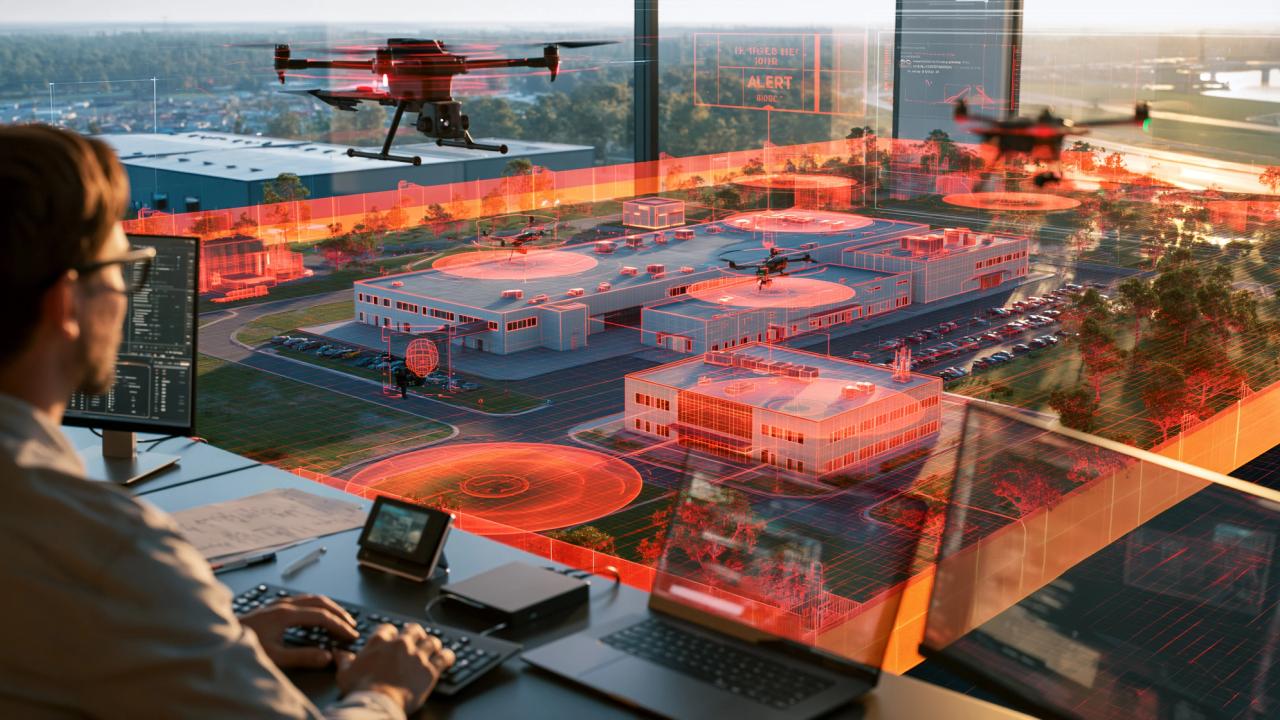
As aerial activity increases, shared visibility becomes increasingly important. A useful operational picture has to connect detection with identification, tracking, context, decision support, and response authority. For infrastructure environments, it may also need to preserve normal operations while an aerial event is being assessed.
This is particularly important because civilian counter-UAS environments impose constraints that differ from battlefield air defense. Airports, utilities, public venues, and urban environments must account for legitimate aviation, communications, public safety, legal authority, and the consequences of mitigation. Detection without coordination can therefore produce awareness without resolution.
Reframing Drone Defense
Drone defense is often discussed as a security problem. Increasingly, it is also useful to think about it as an infrastructure and resilience problem.
Infrastructure is designed to support continuity despite changing conditions. It provides visibility, redundancy, coordination, and mechanisms for maintaining operations when disruption occurs. As drone activity becomes more persistent, protection systems may need to follow a similar model.
Detection, identification, decision support, communications, and legally authorized response become parts of a larger objective: maintaining continuity within a dynamic aerial environment. This does not reduce the importance of detection. It changes the standard by which detection is judged—from whether an object can be seen to whether the resulting information supports timely, coordinated, and proportionate action.
A Principle for the Next Phase
The most important lesson is not about the capability of any individual drone. It is about the operating conditions created when many different aerial systems become persistent, distributed, and increasingly accessible.
Organizations that adapt successfully will likely need more than better sensors. They will need protection architectures capable of sustaining awareness, sharing information, coordinating decisions, and maintaining operations as the aerial environment changes.
Conclusion
The next challenge in drone defense is not detection alone. It is turning detection into durable situational awareness and then connecting that awareness to coordinated action.
As aerial activity becomes more continuous, protection will increasingly be measured by whether an organization can preserve stability within the environment—not simply whether it can identify an event occurring inside it. Detection tells us something is there. Resilience determines what happens next.

Umbrella Aerospace
Umbrella Aerospace explores adaptive approaches to aerial security, autonomous detection, visual intelligence, and counter-UAS systems designed around responsible innovation, operational stability, and the protection of people and critical environments.