When a Sensor Becomes a Supply-Chain Risk
A proposed U.S. restriction on some LiDAR-equipped foreign drones illustrates a larger shift in autonomous technology: governments are beginning to evaluate not only where platforms are manufactured, but which components and capabilities can be trusted inside them.

Summary
LiDAR is widely associated with navigation, obstacle avoidance, mapping, inspection, and machine perception. A current FCC proceeding concerning certain previously authorized foreign-produced UAS illustrates a broader policy shift toward component-level scrutiny. This article examines how trusted autonomy is moving below the platform level, why infrastructure operators may need greater visibility into autonomous-system dependencies, and how supply-chain resilience could affect procurement, continuity, and eventually insurance.
The drone is becoming a technology stack. For years, drone regulation largely treated the aircraft as the relevant unit of analysis. A platform was evaluated by its weight, operator, location, communications characteristics, or manufacturer. That framework is becoming more granular as regulators increasingly look beyond the aircraft itself to the components and systems that make autonomous operation possible.
In December 2025, the Federal Communications Commission added foreign-produced UAS and UAS critical components to its Covered List (PDF) (opens in a new tab) following an executive-branch national-security determination. The agency's documentation specifically identifies communications systems, flight controllers, navigation systems, batteries, motors, ground-control stations, and other components as potential sources of supply-chain or security risk.
Now the question is moving another layer deeper. An FCC proposal released July 21 (PDF) (opens in a new tab) seeks comment on restrictions affecting certain previously authorized foreign-produced UAS deemed “military-grade.” Reporting on the proceeding has highlighted capabilities including thermal imaging, coordinated swarming, and LiDAR. Public comments remain part of the process, meaning the proposal should not be described as a finalized prohibition.
That distinction matters because the emerging policy question is no longer simply who made the drone. It is increasingly what is inside it, what can those components do, and where did they come from?
LiDAR Shows Why the Boundary Is Difficult
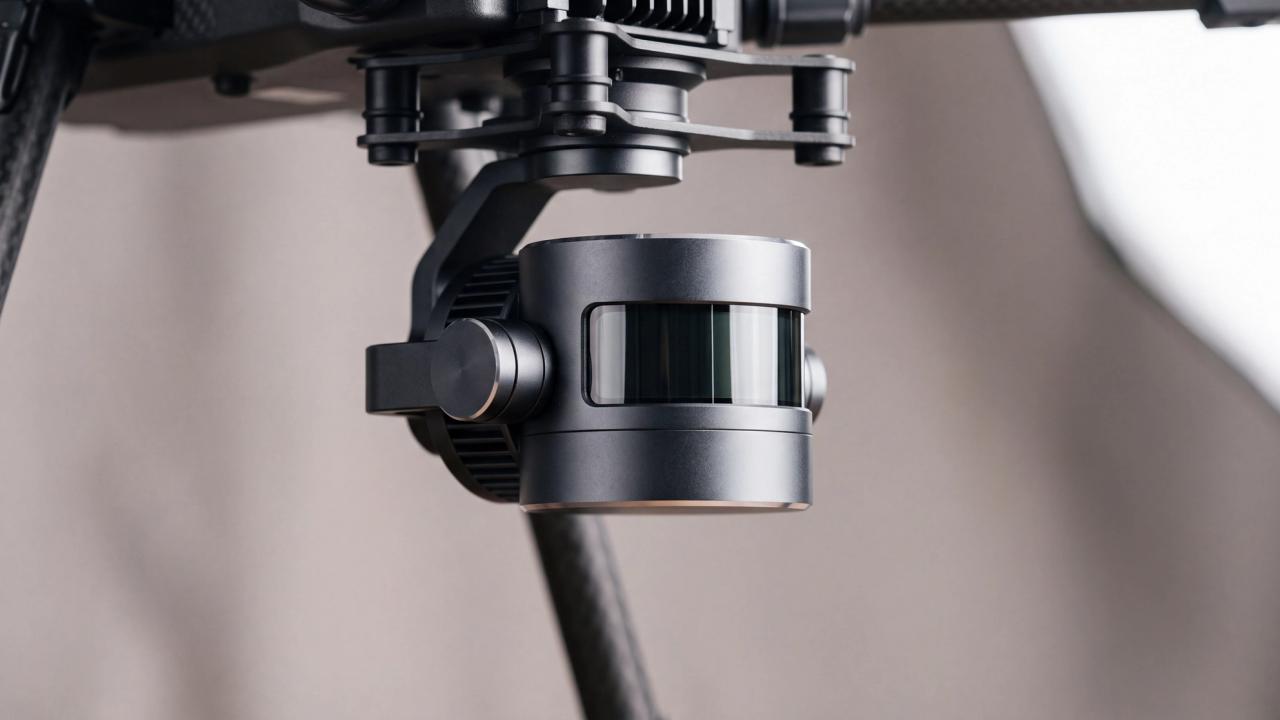
LiDAR makes an unusually revealing case study because it is fundamentally a perception technology. By emitting light and measuring its return, LiDAR allows machines to estimate distance and reconstruct aspects of the three-dimensional environment around them. The technology has applications across robotics, autonomous vehicles, mapping, surveying, and infrastructure inspection. Research published this year in Nature (opens in a new tab) describes LiDAR's increasing deployment across consumer imaging, wearable, and robotic applications.
Drone applications are similarly broad. LiDAR can support obstacle avoidance, terrain mapping, and inspection, while IEEE standards work (opens in a new tab) has specifically addressed UAS-LiDAR surveying of high-voltage transmission infrastructure. These are not inherently military functions, yet the same underlying capability that helps an aircraft avoid a transmission line can also improve navigation in environments where other positioning methods are degraded. A thermal camera can locate a missing person or inspect infrastructure while also providing useful information in a security environment.
Dual-use technology rarely fits cleanly into a single category. That creates a regulatory challenge: policymakers must distinguish between capability, provenance, application, and risk without treating every advanced sensor as equivalent.
Trusted Autonomy Is Moving Below the Platform Level
This debate points toward a larger transformation in autonomous systems because an autonomous aircraft is not one technology. It is an interconnected architecture in which cameras observe the environment, LiDAR may provide depth, navigation systems estimate position, communications systems connect the aircraft to other infrastructure, onboard processors interpret sensor data, computer-vision models classify what the aircraft sees, and software determines what information matters and what action follows.
Each layer introduces dependencies. The FCC's existing UAS framework explicitly reflects this concern. Its December determination cited risks including unauthorized surveillance, sensitive-data exfiltration, and supply-chain vulnerabilities associated with foreign-produced UAS and critical components.
FCC Chair Brendan Carr made the industrial-policy dimension unusually explicit last week. Speaking to Reuters on August 6 about restrictions (opens in a new tab) involving Chinese technology more broadly, Carr said the objective included encouraging companies to onshore production before large numbers of potentially sensitive devices become embedded across the economy.
Whether individual restrictions ultimately prove appropriately calibrated is a separate question. The strategic direction, however, is increasingly clear: trusted autonomy is becoming a component-level issue.
Infrastructure Operators Face a Different Kind of Dependency
For critical infrastructure, the implications extend beyond procurement. Drones increasingly support inspection, mapping, emergency response, asset monitoring, and other operational functions. The sensors enabling those missions can therefore become part of the infrastructure operator's own technology dependency.
Consider a utility using autonomous aircraft to inspect transmission corridors. The aircraft itself is only one element of the operational chain. Its cameras and LiDAR generate data; navigation systems determine where the aircraft travels; communications systems move information between the platform and operator; software processes imagery; machine-learning systems identify anomalies; and cloud infrastructure may store or analyze the results. A disruption anywhere in that chain can affect the mission.
Infrastructure organizations may therefore eventually need to evaluate autonomous technologies in much the same way they increasingly evaluate cybersecurity and software supply chains: not simply by asking whether a product works, but whether its dependencies are understood and manageable.
Resilience then becomes partly architectural. Organizations may need alternate suppliers, interchangeable sensors, diversified communications pathways, auditable software, secure data handling, and systems capable of continuing operation when one component becomes unavailable.
Insurance Will Eventually Have to Price the Stack
The same evolution creates an interesting problem for insurers. Traditional drone underwriting already encompasses physical damage, third-party liability, privacy, and cybersecurity concerns. Swiss Re has previously noted (opens in a new tab) that drone underwriting must account for hardware weaknesses, operator competence, regulatory compliance, and data liability, while also acknowledging the challenge created by limited historical loss data.
Supply-chain restrictions add another dimension. An autonomous operation could depend on a component that becomes difficult to replace, regulatory changes could affect future equipment availability, or a fleet could rely on a sensor, communications module, or software ecosystem concentrated in a single jurisdiction.
These circumstances do not necessarily produce immediate insured losses. But they can influence downtime, replacement cost, operational continuity, and the speed at which an organization can recover from disruption. That places autonomous-system supply chains increasingly close to the traditional concern of business interruption: how quickly can operations resume when something critical becomes unavailable?
The Next Question Is Not Foreign or Domestic
There is an understandable temptation to reduce this discussion to geography, but that would miss the more important lesson. A domestic component is not automatically secure, and a foreign component is not automatically dangerous. Risk depends on design, provenance, cybersecurity, data handling, software architecture, operational context, and the consequences of failure.
The more durable framework will therefore be one built around verifiable trust rather than labels alone. That means understanding what a component does, what information it can access, how it communicates, how it can be updated, where dependencies exist, and whether another component can replace it without disabling the larger system.
For autonomous infrastructure, this may eventually become as fundamental as knowing whether a device is connected to the network.
From Trusted Drones to Trusted Systems
The current LiDAR debate may ultimately produce narrower rules than some early interpretations suggest. The FCC proceeding remains open, and regulatory definitions can change before final action. But the underlying transition is unlikely to reverse.
Drones are becoming more capable because their component technologies are becoming more capable. Sensors are improving, AI models are improving, communications networks are becoming more sophisticated, and autonomy is moving closer to the edge. As that happens, policymakers and infrastructure operators will increasingly look inside the aircraft rather than merely at the logo printed on it.
The future of trusted autonomy therefore will not be defined by a trusted drone alone. It will depend on a trusted system: sensors, processors, communications, software, data, supply chains, and decision architecture working together in ways that can be understood, verified, and sustained.
For organizations preparing for increasingly autonomous environments, that distinction matters because resilience begins with knowing what the system depends on.

Umbrella Aerospace
Umbrella Aerospace explores adaptive approaches to aerial security, autonomous detection, visual intelligence, and counter-UAS systems designed around responsible innovation, operational stability, and the protection of people and critical environments.