The Infrastructure Challenge Emerging in Drone Defense
Recent developments across Europe, North America, and Ukraine suggest drone defense is becoming less about isolated incidents and more about maintaining continuity across interconnected environments.

Summary
This article examines how drone defense is evolving from a response to isolated aerial incidents into a broader infrastructure and resilience challenge. Recent developments in counter-UAS integration, U.S. Army sensor interoperability, commercial investment, and Ukraine’s rapidly adapting defense environment illustrate a common need for persistent situational awareness, coordinated systems, and protection architectures that can support operational continuity across military, public-safety, and critical-infrastructure environments.
Recent developments across drone warfare, public safety, and counter-UAS investment point toward the same underlying shift: aerial activity is becoming increasingly persistent, geographically flexible, and intertwined with the infrastructure that supports daily operations.
The pattern is visible across very different environments. Ukraine continues to demonstrate how rapidly offensive and defensive drone technologies can adapt to one another. In the United States, Lockheed Martin has demonstrated (opens in a new tab) a containerized counter-UAS architecture integrating radar, battle management, and a mobile launcher against a Group 3 one-way attack drone. The U.S. Army has separately emphasized (opens in a new tab) interoperability between sensors and command-and-control systems as it works to improve counter-UAS data flow.
Commercial investment is moving in the same direction. Motorola Solutions completed its $1.5 billion acquisition of D-Fend Solutions in August 2026 (opens in a new tab), explicitly positioning counter-drone capability within public safety, enterprise, airports, critical infrastructure, stadiums, military bases, and border environments. Individually, these developments address different operational problems.
Collectively, they suggest that drone defense is expanding beyond the question of how to stop an individual aircraft. It is becoming an infrastructure challenge involving continuity, coordination, situational awareness, and the ability to operate safely while aerial conditions change.
Drone Activity Is Expanding Beyond Traditional Boundaries
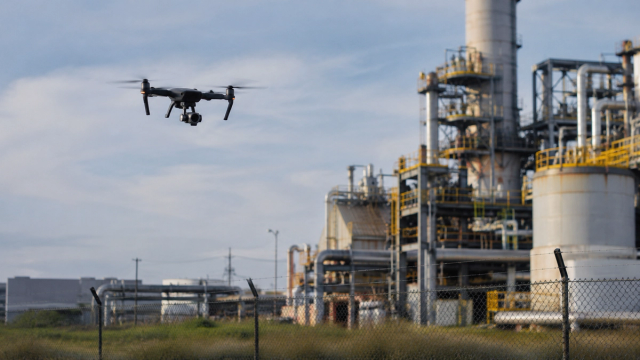
For years, drone defense was often framed primarily as a military problem occurring within defined operational environments. That framing is increasingly incomplete. Long-range systems can reach strategic infrastructure far from conventional frontlines, while public-safety agencies and infrastructure operators are confronting unauthorized drone activity in civilian airspace.
The distinction matters because these environments have different constraints. A military installation, airport, electrical substation, stadium, logistics hub, and urban public-safety operation cannot necessarily use the same detection or mitigation methods. Yet each may require reliable awareness of low-altitude aerial activity and a way to coordinate information across multiple systems.
This does not mean every location faces the same level of risk. It means drone activity is becoming harder to treat as geographically isolated from the infrastructure around it. As systems become more capable, affordable, and scalable, aerial exposure can overlap with transportation networks, energy infrastructure, public venues, logistics corridors, and neighboring jurisdictions.
The Challenge Is Becoming One of Coordination
One of the clearest signals in recent counter-UAS development is the emphasis on integration. Lockheed Martin’s June demonstration (opens in a new tab) combined Fortem R-40 radars, Sanctum mission-management software, a GRIZZLY containerized launcher, and a JAGM interceptor into an end-to-end detection, tracking, decision, and engagement sequence.
The U.S. Army’s Project Flytrap 4.5 addressed (opens in a new tab) a related problem from a different direction: improving data flow and interoperability between the Forward Area Air Defense Command and Control system and an Integrated Sensor Architecture. The emphasis was not simply on adding another sensor or interceptor, but on allowing previously separate elements to contribute to a more coherent operational picture.
That coordination problem becomes more consequential as protection expands into civilian and infrastructure environments. Organizations have to consider how information is shared across systems, how operators maintain visibility across large or distributed sites, how legitimate drones are distinguished from unauthorized activity, and how response authority changes across jurisdictions. These are infrastructure questions as much as security questions.
Drone Defense Is Gradually Becoming a Resilience Function
Recent investment also suggests that counter-drone capability is moving deeper into public-safety and infrastructure ecosystems. Motorola Solutions’ acquisition of D-Fend Solutions adds RF cyber-takeover counter-UAS technology to a portfolio already centered on mission-critical communications, public safety, and enterprise security. Motorola said D-Fend’s technology (opens in a new tab) has been deployed across airports, critical infrastructure, stadiums, military bases, and borders in more than 30 countries.
The significance is broader than a single acquisition. It reflects a market in which drone protection is increasingly connected to operational continuity: maintaining communications, preserving authorized drone activity, avoiding unnecessary shutdowns, and giving operators enough situational awareness to make proportionate decisions.
The same resilience pressure is visible in active defense environments. Ukraine is confronting faster jet-powered drones (opens in a new tab) that are reducing the effectiveness of some existing interception methods, prompting manufacturers to accelerate development of new interceptor systems while facing component and production constraints. The recurring pattern is adaptation: protection cannot remain static when the aerial environment continues changing.
A Different Way to Think About Protection
The most important signal is therefore not simply that drone technology is advancing. That has been clear for years. The more consequential shift is that aerial activity is becoming a continuing operational consideration across a growing range of environments.
That changes what protection has to accomplish. Detection remains essential, but detection alone does not provide continuity. Organizations also need identification, information sharing, decision support, defined authorities, operational procedures, and response options appropriate to the environment. In many cases, those capabilities have to work across organizational or geographic boundaries.
This is why drone defense increasingly resembles infrastructure. Effective protection depends on connected layers that remain available over time rather than a single technology activated only after an incident begins.
Conclusion
As aerial activity becomes more persistent, the conversation will increasingly move from individual aircraft and isolated incidents toward continuity, coordination, and long-term resilience. The relevant question is not only whether a drone can be detected or intercepted, but whether the surrounding environment can maintain awareness and stable operations as conditions change.
For critical infrastructure and public-safety environments, that may require a combination of centralized coordination and localized protection—systems designed to share information, preserve operational continuity, and support measured responses within clearly defined legal and safety boundaries. When aerial activity becomes persistent, drone defense stops functioning only as incident response. It becomes part of the infrastructure required to maintain stability.

Stephanie N. BlahutVP of Marketing
Stephanie N. Blahut is a growth marketing leader at Umbrella Aerospace, where she leads brand strategy, market positioning, and go-to-market initiatives. She writes about the evolving counter-UAS landscape and the market forces shaping the future of drone defense.