The Next Challenge in Drone Defense Is Knowing What Not to Stop
More than 700 unauthorized drones were seized during the 2026 FIFA World Cup. None were found to be weaponized. That distinction points toward one of the most important challenges facing counter-drone infrastructure: determining not simply what is in the sky, but what actually requires intervention.

Summary
The 2026 FIFA World Cup offers a revealing counter-UAS case study: authorities seized more than 700 unauthorized drones, yet none was found to be weaponized. As legitimate drone activity expands, detection alone will become increasingly insufficient. Future protection systems will need to combine aircraft identification with authorization, behavior, trajectory, sensor fusion, and operational context so operators can distinguish credible threats from benign or merely unauthorized activity. The next counter-drone challenge is therefore not only knowing what to stop, but knowing when intervention is unnecessary.
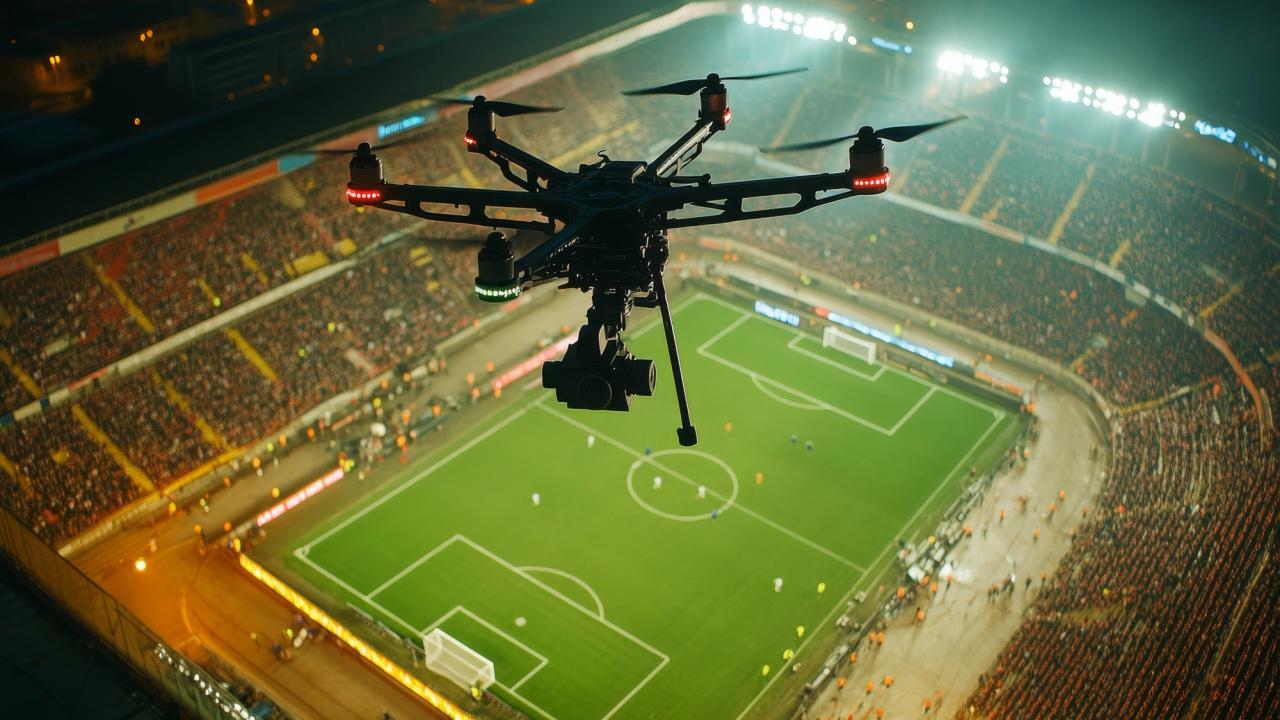
During the 2026 FIFA World Cup, federal, state, and local authorities conducted what the Federal Aviation Administration described as the most comprehensive airspace-security and drone-mitigation effort in U.S. history. Nearly 250 temporary flight restrictions (opens in a new tab) were established around stadiums, fan festivals, team hotels, and training sites, and more than 700 unauthorized drones were seized across the 11 U.S. host cities.
The scale alone is noteworthy. But another detail may be more important for the future of counter-drone systems. A White House official subsequently confirmed (opens in a new tab) that none of the recovered drones were found to be weaponized and said most incidents involved hobbyists or people unaware of the restrictions.
That does not make the incursions harmless. Unauthorized aircraft near crowded venues create legitimate safety and security concerns regardless of operator intent. But the distinction illustrates a larger challenge emerging as drones become commonplace: the future problem will not simply be detecting drones. It will be determining which drones matter.
Detection Is Becoming the Beginning of the Decision
As we explored in our previous article, The Next Challenge in Drone Defense Is Not Detection (opens in a new tab), identifying an aircraft is only the first step in a larger process of assessment, coordination, and response. The World Cup experience pushes that argument one step further: as drone activity becomes more common, effective protection will depend not only on knowing what is in the sky, but on determining what actually requires intervention.
Traditional security systems often operate around a relatively straightforward assumption: detecting something unusual is itself valuable. For drone security, that assumption becomes less useful as the number of aircraft increases.
Commercial inspection drones, public-safety aircraft, delivery systems, media platforms, recreational aircraft, infrastructure-monitoring systems, and increasingly autonomous fleets may occupy overlapping environments. FAA figures already count (opens in a new tab) more than 837,000 registered drones and more than 480,000 certificated remote pilots in the United States. As commercial operations expand, particularly beyond visual line of sight, legitimate low-altitude activity is likely to become more complex.
In that environment, treating every detection as a potential threat creates a different problem: operational overload. Security personnel cannot treat every detection equally, nor should automated systems assume that an unidentified object is necessarily hostile. Detection increasingly needs to feed a larger decision process: What is the aircraft? Is it authorized? How is it behaving? Does its trajectory match an expected operation? What assets or people could be exposed? Does the situation require observation, warning, intervention, or no action at all?
Those questions move counter-drone systems beyond object detection and toward contextual understanding.
The World Cup Was a Preview of High-Density Airspace Security
The World Cup provides an unusually useful case study (opens in a new tab) because authorities were protecting multiple types of locations across a geographically distributed environment. Restrictions covered not only stadiums but surrounding venues, fan gatherings, hotels, and training locations. Federal and local teams supported detection, mitigation, and enforcement operations.
The result was a large-scale operational test of something likely to become more common: security teams maintaining protected airspace boundaries while substantial drone activity continues around them. Hundreds of aircraft entered restricted areas, demonstrating the scale of the identification and enforcement problem. The fact that none of the recovered aircraft was ultimately found to be weaponized also demonstrates why identification cannot end with detection.
A system designed around maximum sensitivity may successfully detect enormous numbers of objects while simultaneously increasing the burden on the people responsible for deciding what those detections mean. The better objective is not simply greater detection. It is better discrimination.
Authorization May Become as Important as Identification
Counter-drone systems have traditionally emphasized characteristics of the aircraft itself: platform type, size, speed, communications signature, or other observable features. Those characteristics remain valuable, but they do not necessarily answer the operational question.
Two visually identical drones can represent entirely different situations. One may be an authorized infrastructure-inspection platform. Another may be a recreational aircraft that accidentally crossed a boundary. A third may be intentionally surveilling a protected facility. Appearance alone cannot reliably distinguish among them.
Future security architectures may therefore need to combine multiple layers of information: visual classification, trajectory analysis, Remote ID or other available identity signals, authorization records, geofencing information, behavioral patterns, sensor fusion, and the operational context surrounding a protected location.
The objective is not simply to label an aircraft. It is to understand whether its presence makes sense. That becomes especially important as autonomous operations expand. A security architecture that cannot distinguish expected autonomous activity from anomalous activity risks creating friction with the systems increasingly being deployed across logistics, transportation, inspection, emergency response, and infrastructure management.
Counter-Drone Authority Is Expanding Alongside the Technology
This challenge is becoming more important because counter-drone capability is expanding beyond a narrow group of federal users. The 2026 SAFER SKIES framework (PDF) (opens in a new tab) established a pathway for qualified state, local, Tribal, and territorial law-enforcement and correctional agencies to conduct specified counter-UAS activities under federal training, certification, oversight, privacy, airspace, spectrum, and reporting requirements.
That expansion creates opportunity, but it also raises the importance of disciplined decision-making. A broader network of authorized operators will require technologies that help users interpret situations consistently rather than simply present them with additional sensor feeds.
The interface between detection and response therefore becomes critical. Systems need to help operators move from “something is there” to “we understand what it is, why it may be there, how it is behaving, and what action is appropriate.” That is a substantially different technical problem.
Protection Will Depend on Restraint as Much as Response
The evolution of counter-drone infrastructure is sometimes described primarily in terms of increasingly powerful mitigation technologies. But the World Cup experience suggests another direction: as the sky becomes more crowded, effective protection will depend partly on the ability to avoid unnecessary intervention.
That requires confidence in detection, identification, authorization data, behavioral analysis, and the ability to distinguish a credible threat from an aircraft that is merely unexpected. The strongest protective architecture may therefore spend most of its time observing, classifying, and evaluating rather than responding.
Intervention becomes the final stage of a much larger decision process. That approach also reflects a broader reality about autonomous environments: as machines increasingly operate alongside people and other machines, security cannot depend entirely on exclusion. It must become capable of understanding context.
From Drone Detection to Airspace Understanding
The more than 700 drones seized during the World Cup should not simply be interpreted as evidence that unauthorized drone activity is widespread. They illustrate the scale of the decision problem ahead.
Authorities had to detect aircraft, assess them, locate operators, enforce restrictions, and determine whether any represented a larger threat. As autonomous aircraft become more common, similar decisions will increasingly occur around airports, utilities, logistics facilities, industrial sites, stadiums, transportation corridors, and other critical infrastructure.
The central question will gradually change from “Is there a drone?” to “Should this drone be here?” Building systems capable of answering that question reliably may become one of the defining challenges of the next generation of autonomous security infrastructure.
Conclusion
For counter-drone technology, detection is no longer the destination. It is the beginning of the decision. The next generation of protection will depend on systems that can combine detection with identity, authorization, behavior, trajectory, context, and clearly defined response authority.
As legitimate and unauthorized drone activity increasingly share the same low-altitude environment, effective security will be measured not only by what a system can stop, but by how reliably it can determine what should not be stopped.

Umbrella Aerospace
Umbrella Aerospace explores adaptive approaches to aerial security, autonomous detection, visual intelligence, and counter-UAS systems designed around responsible innovation, operational stability, and the protection of people and critical environments.